Look at the approach
A doorway is often treated as a line between outside and inside. In daily use, it behaves more like a small room. People slow down, search for a key, hold a parcel, read an entry panel or wait for someone ahead to move through.
Begin a few steps away from a familiar entrance. Is the route obvious? Can you see where the door opens and where a person might wait without blocking the path? Lighting, shelter and a level approach shape the experience before anyone touches the handle.
Keep the observation general and respectful. An entrance may lead to someone’s home or workplace. Do not record access codes, photograph residents without permission or interfere with the door while people are using it.
Notice the choreography
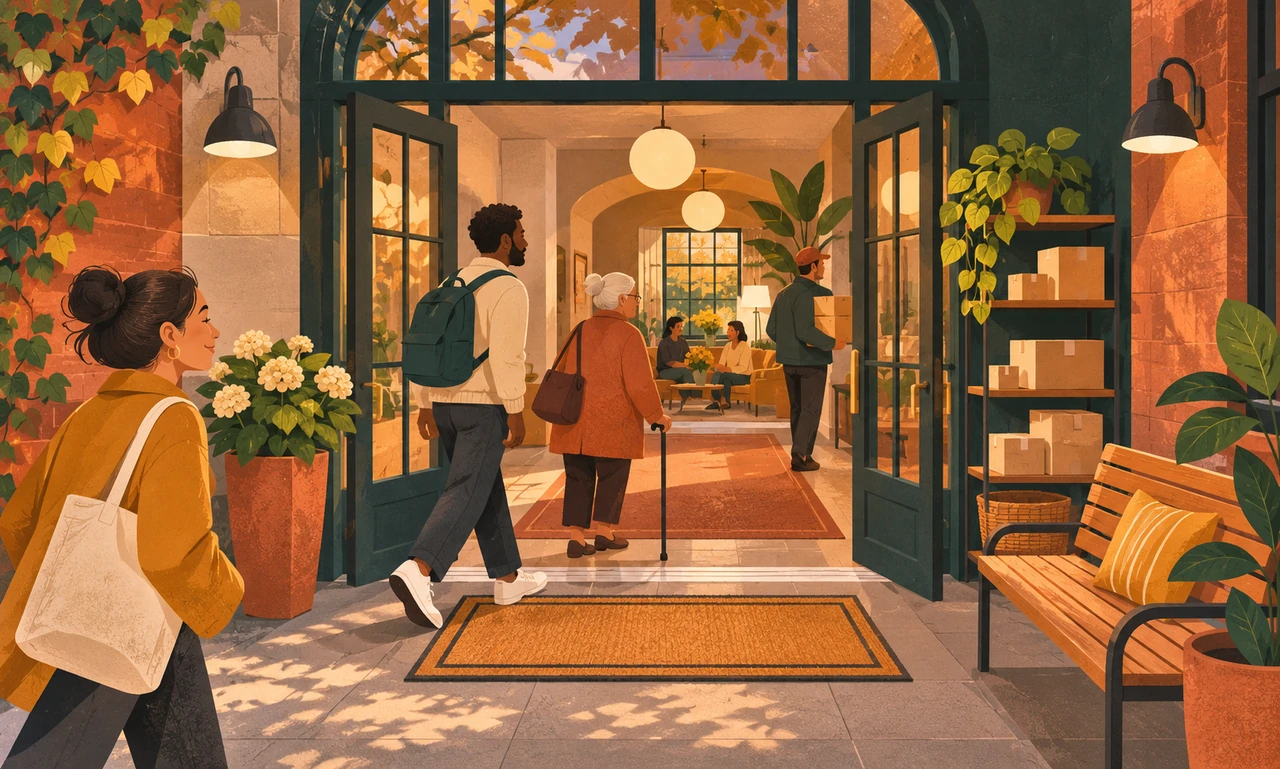
Two people approaching from opposite directions must briefly negotiate who passes first. A person carrying shopping may need more space. Someone using a mobility aid may approach the handle at a different angle. A delivery worker may pause with a cart before crossing the threshold.
The swing of the door matters, but so do the objects around it. A mat can define the landing area. A bench may offer a place to organize belongings. Packages, bicycles or decorations can turn useful space into an obstacle when they spread into the route.
Describe conditions rather than assuming an experience for everyone. “The door opens across most of the landing” is more useful than declaring the entrance easy or difficult on behalf of people you have not asked.
Treat welcome as a practical detail
A welcoming entrance is not only a matter of decoration. Clear directions, working light, visible numbering and a path free of clutter can reduce uncertainty. In a shared building, these details depend on maintenance and habits as much as design.
If you notice damage or an access concern, report the exact location and visible condition through the appropriate owner or service. Do not attempt repairs to security, electrical or automatic-door equipment without authorization and suitable expertise.
The threshold is brief, but it sets the tone for everything beyond it. Paying attention to this first room reveals how a building introduces itself: where it asks people to wait, how it makes space for arrival and whether entering feels like a clear next step.
About this article
An original perspective from Everyday News. It offers practical ideas and perspective rather than firsthand reporting.